Tsunami Disaster
Selected Location for Project 1: Sumatra, Indonesia

http://upload.wikimedia.org/wikipedia/commons/8/80/US_Navy_050102-N-9593M-040_A_village_near_the_coast_of_Sumatra_lays_in_ruin_after_the_Tsunami_that_struck_South_East_Asia.jpg
Precedents of Shipping Container Architecture
12 Container House
A house designed by Adam Kalkin, with 12 shipping containers forming the basis of the design. The containers are partially used for structure and also form part of the floor planning. On the bottom floor is an open plan area flanked by 6 of the containers, each dedicated to a different room. 2 stair cases lead up to either side to the other 6 containers, 4 of which are bedrooms, and 2 bathrooms.

http://bestofshippingcontainers.com/wp-content/uploads/2013/12/12-container-house-adam-kalkin-3.jpg

http://ideasgn.com/wp-content/uploads/2013/10/12-Container-House-in-Blue-Hill-Maine-idea+sgn-by-Adam-Kalkin-Plan1.jpg
The Future Shack Container House
A mass produced, relocatable house designed by Sean Godsell Architects. It is designed for: mass production, flexibility, ease of siting and self containment.
Steel shipping containers are mass produced and a inexpensive universal module which forms the backbone of the design.
When in "storage mode", the containers can be stacked and shipped easily.
It has legs that telescope from the bottom of the container allowing it to be sited on uneven terrain without excavation.
Every utility needed is already packed within the module.

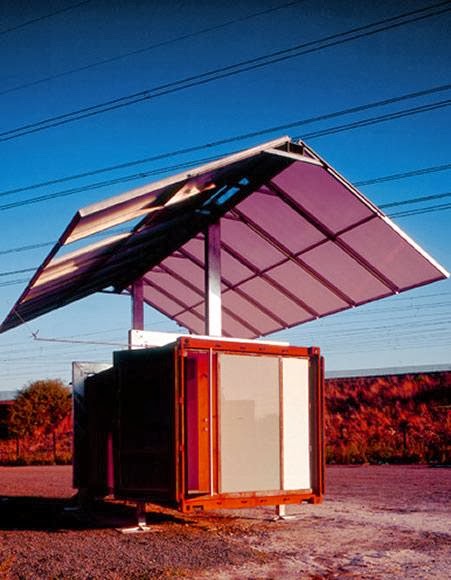
http://www.residentialshippingcontainerprimer.com/sites/default/files/imagecache/lightbox/future-shack_02.jpg
Comparison in Features
Similarities:
- Containers form the basis of the design
- Tries to reduce costs by using recycled materials, mainly the containers.
- Are both green - solar panels
- Re-usable/recyclable
Differences:
- Future shack has minimum utilities needed for human living - 12 container house is relatively "extravagant"
- Future shack can be moved and re-sited with immense ease - can be assembled on site in 24 hours
- Future shack is mass producible
Comparison in Design Approaches
Similarities:
- Designed to make use of shipping containers, and to display the way they can compartmentalise living.
Differences:
- 12 Container House built for luxury, and comfortable living - Future Shack is built for relief housing for the poor, the displaced.
- Future shack is designed to be changed in small ways depending on where it is based, to suit the cultural needs of the people it house. For example, it's roof can be changed out with indigenous materials like thatch and palm leaves to make the occupants feel more at home.
My Project
- Telescopic legs. This will be extremely useful in flood affected areas, to create a dry environment "above" the destruction.
- also make sit easy to set up
- Recycled materials to minimise costs
- Solar panels for power
- Ability to add and take away elements within the container - ie kitchen, bedroom, living area
- This would be useful for families that are too big for one container, but don't need twice the amenities as one container.
- Slanted roof? Adds the sense of home, but if too big, makes it harder to transport.
- Self-containability
- Stackability - stack multiple containers together to create a mini apartment block
- increases the amount of people you can safely fit into one area.

No comments:
Post a Comment